A Mayo GAA legacy that has stood the test of time
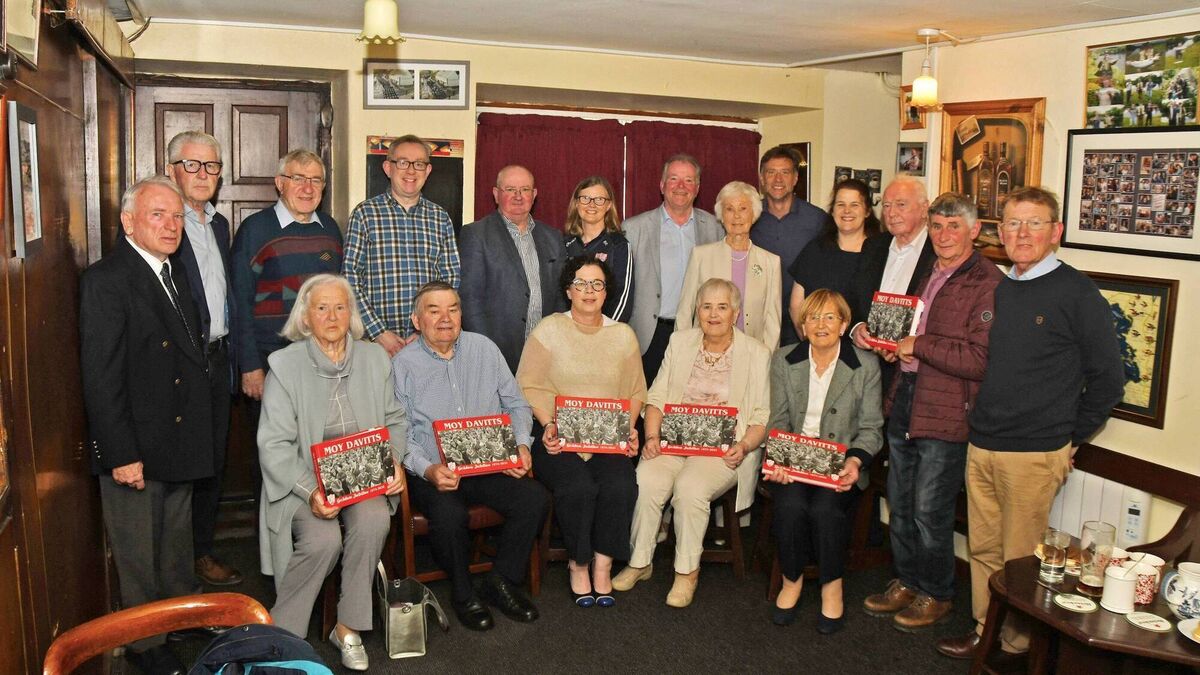
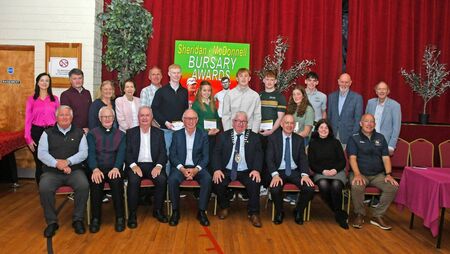
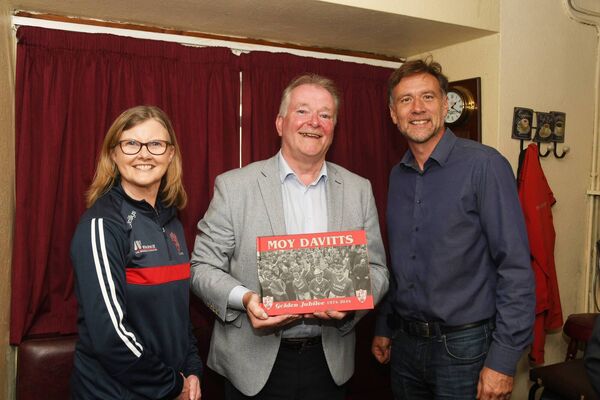
Pictured at the Moy Davitts club event in Guiry's Bar in Foxford were, back row, from left: Cathal Hennelly, Club President; Kieran Heneghan, Michael Lavin, James Laffey, Fergal Geoghegan, Bernie Ryder, Club Secretary; Willie Byrne, club chairperson; Deirdre Bonham, Rory Conway, Yvonne Ruane, Finian Conway, John Gilmore, Paddy Colleran. Front row: Mary O'Neill, Michael Brogan, Alison Bonham, Eithne Brogan, Patricia Colleran. Picture: John O'Grady
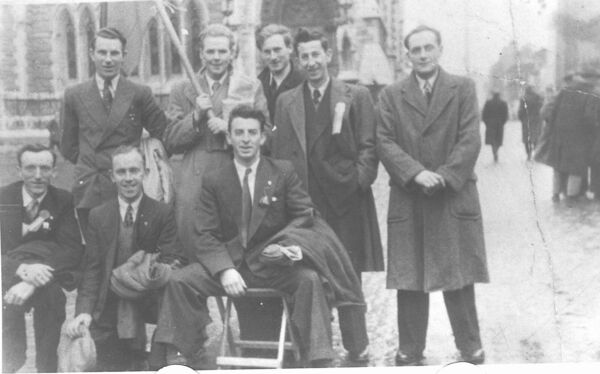
The first time this writer heard of Pat Conway was in 2003 while researching a history of my hometown of Foxford. Conway had been treasurer of the Mayo County Board in the All-Ireland winning years of 1950 and ‘51 and can be seen in that iconic photograph of the 1951 team, standing on the extreme right beside trainer Gerard Courell.
The voluntary role of treasurer of the County Board cannot have been easy in those cash-strapped days, but then Conway came from a generation who knew a thing or two about hard times. Thirty years earlier, as a student teacher, he had come under the suspicion of the Black and Tans for carrying communiqués for the IRA between Dublin and Mayo.
Seán Lavin, retired principal of Foxford National School and a great local historian, recalled his father Tom telling him of a dramatic raid by the Black and Tans on Conway’s terraced home in Irishtown in the summer of 1921. Tom, then a boy of six, remembered his neigbhours’ belongings being flung onto the street as the Crown forces searched for the evidence that would incriminate their suspect. Fortunately, Conway was working on the bog in Shraheen and a messenger was promptly dispatched to warn the young teacher not to return home. He immediately stopped what he was doing, walked along the railway track into Foxford station and hopped on the first train out of town.
Conway was lucky. Six young men who were captured by the Black and Tans in Foxford around the same time were subjected to a night of torture, culminating in them being flogged with whips and thrown off the bridge into the River Moy. Indeed, one of the most fascinating interviews this writer has ever conducted was with Tom Durcan, who was just ten years old in 1921 and living in Belass on the Ballina side of Foxford.
“I used to be out herding cattle on the road, and I would hear the Black and Tans’ lorries coming. I would just leave the cattle on the road and hide in a field, maybe behind a wall or a hedge. No-one wanted to be seen by the Tans. People would do anything to avoid being seen. We were terrorised by them, everyone lived in fear of being stopped and questioned.”
Tom, who was already developing a life-long love of Gaelic football, recalled the curfew imposed by the Black and Tans during May and June of 1921.
“I can remember sitting inside on a glorious summer’s evening when we couldn’t step outside for fear of being shot. People hear on the news about curfews in other countries, but I saw it here in my own town. It’s something I will never forget.”
Tough times, indeed.
Halcyon Days
Pat Conway shared Tom Durcan’s enthusiasm for Gaelic games, having growing up in an era when Foxford – with its easy accessibility by road and rail – was often the venue for big club games involving the likes of Ballina Stephenites, Castlebar Mitchels and Charlestown Sarsfields. In September 1915, the town hosted the Mayo Senior Football Final between Ballina and Ballyhaunis, with the game being played in a meadow on the banks of the Moy. Frank Dorr, the first secretary of the Connacht GAA Council, lived locally and was one of the organisers of an annual sports day, held in mid-August and played under GAA rules.
By the mid-1930s, GAA in Mayo was enjoying a golden age as the county’s senior footballers claimed All-Ireland and National League honours, yet the association had all but disappeared in Foxford, other than some handball played in the alley near Durcan’s home in Belass. In December 1937, a contributor to the Western People remarked that it was “a deplorable thing that the game has been allowed to die out” in the town.
“All we want is someone to show the way, organise the youngsters and get things going again,” he remarked.
Step forward Pat Conway, now a local schoolteacher, who was determined to restore Foxford’s proud GAA tradition, which stretched all the way back to the 1890s when the town boasted its own team, the Geraldines.
Conway’s revival began in nearby Toomore during the war years of the 1940s when he, Josie Hennelly (father of current Moy Davitts stalwart Cathal) and a few others, including the renowned Laffey brothers from Renbrack, established a team that claimed an East Mayo Junior Championship in 1945.
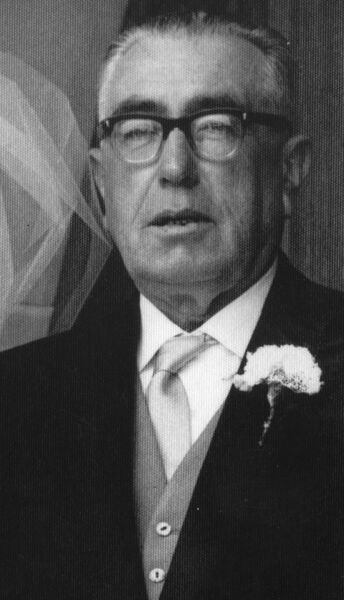
A year later, Conway managed a Foxford minor team that won a rare county championship by defeating the powerhouses of Ballina Stephenites and Castlebar Mitchels in the semi-final and final respectively.
“Foxford’s victory over Ballina was a signal triumph for Mr. P.J. Conway, N.T., who had the winners in the peak of form,” wrote the Western People. “They were trained to the ounce; and are the most uniform lot one could wish to see.”
Pat Conway’s ambition was to have a proper GAA pitch in Foxford, and he identified a plot of land at Sraith Garbh, along the banks of the Moy. In the early 1950s, he called a public meeting at which ten local people guaranteed £40 each toward the purchase price of £400, a huge sum in those days. By careful purchasing and swapping of parcels of land, an area of some six acres was acquired for the newly formed Foxford GAA Club and some development work commenced.
Conway had assistance from several other local GAA enthusiasts, including Tom Durcan, now a member of the staff of Foxford Woollen Mills and a wonderful community stalwart, whose son John was one of a group of youngsters that Pat recruited to assist with his work as Mayo GAA treasurer. John recalled selling tickets from an old leather schoolbag for inter-county games. He got free admission to the games and a feed afterwards, but only after the pennies and shillings had been balanced with the number of tickets sold.
John was ten years old when Mayo defeated Meath to retain the All-Ireland senior title in 1951. He listened to the game on the radio, hanging onto every word uttered by the great Micheal O’Hehir as the action swept from one end of the field to the other, and the crowd gathered around the old battery wireless cheered and groaned with every goal or point scored or conceded. The following night, John and his school friends lined the streets of Foxford as the Sam Maguire Cup was paraded through the town.
Michael Staunton, another great local GAA stalwart, was also there that night and recalls Mayo captain Seán Flanagan telling the crowd that “the only thing warmer than a Foxford blanket is a Foxford welcome”. The cup was even brought into the home of Fr Packie Dorr, a nephew of Frank, who was recovering from a serious illness contracted while serving as a missionary priest in Africa.
Before the team left Foxford, Pat Conway handed the famous trophy to a wide-eyed ten-year-old boy.
“Hold it tight,” he instructed young John Durcan, “because it could be a long time before you hold it again.”
Divided loyalties
Another key man in the Foxford GAA revival of the 1950s was Dom Geoghegan, a native of Co Down who was sent as a machine engineer to the local Woollen Mills for a couple of weeks and ended up moving to the town after meeting Mills employee Kathleen McTigue. Dom and Kathleen raised their family on Chapel Road, across from the Brown Memorial Hall, and GAA was never far from the conversation at the kitchen table.
“My Dad had played for Down in the late 1940s so former Down players would often call to visit him,” recalls Fergal Geoghegan. “Footballers like Colm McAlarney, Pat Rice and Sean O’Neill often dropped into our house for a cup of tea.”
The 1960s was the golden age of Down football with the Mourne County claiming All-Ireland senior titles in 1960, 1961 and 1968. It was a big deal for the young Fergal to come in from school and find an All-Ireland winner sitting at the kitchen table, but in 1970 he faced something of a dilemma when Mayo met Down in the National League Final. Unsure of which team to support, the ten-year-old sought the advice of his father on the train to Dublin.
“Son,” replied Dom, “always support your home team, regardless of where you go.”
The message could hardly have been clearer: Dom would be supporting his beloved Down, but he wanted his son to cheer for Mayo. What a lovely way of explaining to a child that core principle of the GAA, namely a lifelong devotion to one’s native place. Mayo scored four goals that day in a famous victory, and Fergal cheered every one of them to the last.
A few months after that triumph, Pat Conway passed away in a Dublin hospital, having spent his final years promoting hurling and camogie in Foxford. In total, he served 17 years as Mayo County Board Treasurer, stepping down in 1963 following a trip to the United States with the senior team. His final years were spent imbuing a love for the GAA in a new generation of youngsters – men like John Gilmore and Michael Lavin – who would go on to play important roles in the establishment and growth of Moy Davitts from the mid-1970s.
It wasn’t easy for Conway to keep the GAA torch burning during an era of mass emigration. Many of the young players that he coached in the 1940s and 1950s ended up taking the emigrant boat or plane when they were still in their sporting prime. One of the few opportunities open to young men was An Garda Síochána, and John Durcan gratefully seized it.
After completing his training in 1964, John was posted to the sleepy village of Carrigans on the Donegal border with Derry.
“It was the day that Winston Churchill was buried,” he recalled. “I wasn’t too used to television, but I saw it that day.”
John had never been to Carrigans before, and he arrived at his lodgings late at night. The following morning, he opened the front door to inspect his new bailiwick. The street wasn’t much longer than the bridge in Foxford.
“Is this it?” he asked the landlady incredulously.
“That’ll be it,” came the laconic reply.
And she wasn’t exaggerating.
By the early 1970s, John had moved to the more lively Donegal Town, built a home, got married and started a family. The love of the GAA that had been passed onto John by his father was now handed onto his children, who travelled with him to games involving both Donegal and Mayo. John was one of Mayo’s most loyal supporters and loved nothing more than to bump into someone from his home county while on the beat in Donegal Town.
“Whenever I’d travel to Donegal as a sales representative I’d always try to drop into John Durcan to have a chat about Mayo GAA,” Cathal Hennelly recalls. “I remember one afternoon standing in The Diamond with him and he was asking me: ‘When will we ever get Sam Maguire back to Foxford again?’”
There were divided loyalties in the Durcan household in 1992 when Donegal met Mayo in the All-Ireland semi-final, with the Ulster champions prevailing en route to a first All-Ireland senior title. The family garden became a mini-Croke Park as John’s boys played long into the summer evenings. Adrian and Sean were a little older than Paul, so they’d put him in goal and smash shots at him. It was a good apprenticeship for a future intercounty goalkeeper.
Paul played a lot of his underage football outfield with the Four Masters Club, and it wasn’t until he was in the U16 grade that the Donegal great Martin McHugh saw his potential as a goalkeeper, giving him the No 1 jersey for the Ted Webb Cup in 1999. Paul made his senior debut for Donegal in 2004 and won the Sigerson Cup with Sligo IT a year later before claiming National League honours in 2007 with victory over his father’s native Mayo in the final.
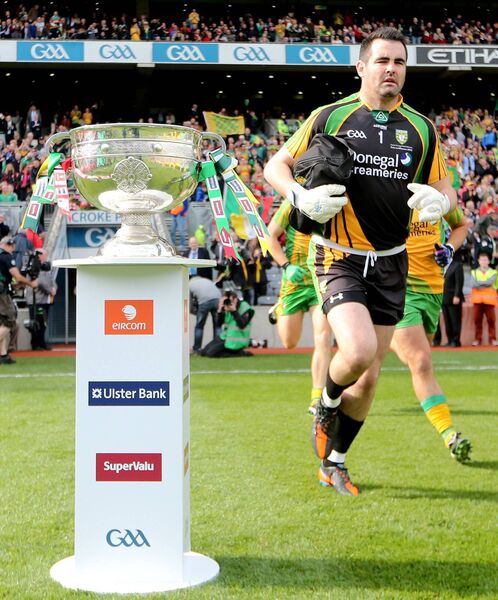
By the time Jim McGuinness became Donegal manager in late 2010, Paul was well established as one of the leading goalkeepers in the country and was among the first names on the team-sheet for the new manager, becoming an ever present as Donegal won the Ulster Championship in 2011, their first since 1992. A year later, McGuinness’ men had a bigger prize in their sights, but another resurgent team stood in their way in the All-Ireland Final: John Durcan’s beloved Mayo.
“Always support your home team, regardless of where you go,” Dom Geoghegan had advised his young son, but how do you support your home team in an All-Ireland Final when your son is playing for the opposition? Not even Dom would have been able to solve that riddle.
At least John Durcan wasn’t alone as two other Mayo-born Garda colleagues, Mick Murphy and Terry O’Reilly, also had sons on the Donegal panel – captain Michael Murphy and substitute Martin O’Reilly. All three gardaí were interviewed by Alan Foley of the Irish Examiner in the build-up to the game and the article has proven very useful to this writer in my research.
Everyone who knew John from his childhood in Foxford were only too aware of the impossible dilemma he faced on that All-Ireland Final Sunday in 2012.
“It was very tough on John because there is no prouder or more passionate Mayo GAA man than him,” says his sister Eithne Brogan. “He travelled all over the country supporting Mayo and never missed a match in Croke Park. It was a shame that it had to be Mayo in the final when Paul played for Donegal, but at same time our dad would have been so proud to have had an All-Ireland senior medal winner in the family. It was certainly a day of mixed emotions.”
John Durcan was in the crowd when the Sam Maguire arrived into The Diamond in Donegal town on the Monday evening after the final. The first person he thought of was his old mentor Pat Conway and the advice he had given him in Foxford some 61 years earlier: Hold it tight because it could be a long time before you hold it again.
Enduring legacy
On Friday evening, May 8th last, Moy Davitts GAA Club hosted a wonderful event in Guiry’s Bar in Foxford to honour the legacy of Pat Conway, Tom Durcan and Dom Geoghegan. All three were trustees of the old Foxford GAA pitch that became home to Moy Davitts when Tom and Dom agreed to sign it over to the club in 1981. In a powerful address, Cathal Hennelly described their decision as “the single most important benefit” to the Moy Davitts club in its 52-year history, and one that paved the way for the development of the modern facility that became Sraith Garbh.
The event, expertly organised by Cathal, club chairperson Willie Byrne and secretary Bernie Ryder, was attended by Tom’s daughters Eithne Brogan and Patricia Colleran (from Charlestown whose husband Paddy comes from one of Sligo’s most distinguished GAA families), Dom’s son Fergal, as well as several members of the Conway family – Pat’s children Deirdre Bonham and Finian Conway and grandchildren Alison Bonham and Rory Conway. Rory’s late father Enda co-founded the Irish Planning Institute in Dublin and was tremendously proud of his Foxford and Mayo heritage.
Like John Durcan, Enda Conway passed on his father’s passion for the GAA to his own children, and Rory recalled finding dozens of old hurleys in a shed in the family home in Dublin, a relic from Pat’s days as a champion of the small ball in Foxford. Rory is now based in Zurich and is chairperson of Gaelic Games Europe, which was established in 1999 to promote football, hurling, camogie and rounders across the continent. Today, it has more than 3,000 members in 15 countries, stretching from Moscow to Galicia in Spain and from Oulu in Finland to Gibraltar.
Membership continues to rise, especially among young women who are keen to become involved in Gaelic football, not just for physical fitness but also for the social connections that come from being involved in a GAA club. Rory spoke with passion and eloquence about his work in promoting the GAA overseas and the preparation for the World GAA Games in Waterford next month. The same infectious enthusiasm that drove his grandfather to establish a football club all those years ago was evident for all to see as Rory articulated a vision for the GAA that goes well beyond this island.
Pat’s daughter Deirdre also addressed the gathering, reflecting on the often unheralded role of women in the GAA in those early years, including her mother Lily who would regularly have a clothes line of football jerseys from one of the many teams that Pat managed.
Despite moving to Dublin for college and work in the 1970s, Fergal Geoghegan continued to line out for Moy Davitts, alongside his younger brother Liam. He later became heavily involved with the Kilmacud Crokes club, training youngsters who went on to play senior inter-county. But there was never any doubt about who he was supporting when the Dubs met his native Mayo, as they did on so many occasions in recent years. Dom’s advice remained the lodestar that Fergal and Liam followed as adults, and their passion for Mayo GAA is undimmed, despite spending their entire adulthood living away from the county.
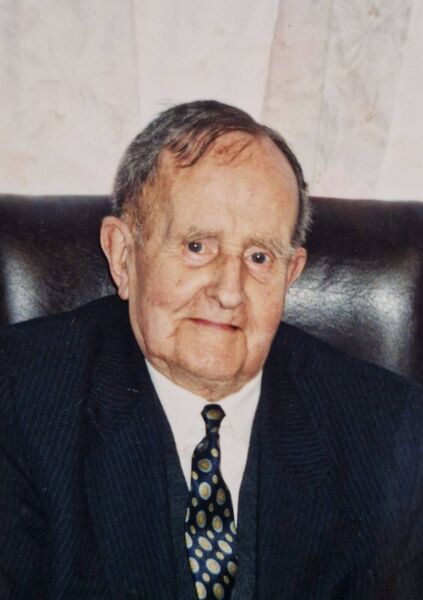
Tom Durcan’s great-grandchildren – the family of Yvonne Brogan and Michael Ruane – ended up playing football on the field he handed over to Moy Davitts all those years ago. Two other great-grandchildren Emily and Katie Brogan have won All-Ireland underage titles with Galway in camogie and football. Emily was recently selected on the Galway senior camogie panel, having been a member of the panel that won the All-Ireland U23 Championship last year. Younger sister Katie has won All-Ireland underage titles in football (U14) and camogie (U16), as well as a world handball title - a remarkable treble at such a young age. Their father Gary is an ardent Mayo fan who, like the rest of us, has endured many a tribulation on All-Ireland Final Day.
The world may now be a very different place from the one that Tom Durcan knew in his childhood, but the one institution that has endured is the GAA, and it has done so because of the strong foundations laid by men like Tom, Pat and Dom, and their equivalents in every town and village across this county and country. They were like those famous railroad pioneers of the nineteenth-century who laid the tracks from east to west in the United States, heroically breaking new ground, and in so doing, bequeathing a legacy to future generations that becomes more precious with every passing year.
One house, a lot of history
When the Census of 1926 was published last April, one of the first tasks this writer undertook was to check out the occupants of the terraced house in Irishtown, Foxford, where I was born and reared. Pat Conway, then aged 26, was living there with his parents James and Catherine, and younger siblings, Katie (17) and John (14). Three doors down were the Lavin family – Tom (11), who witnessed the Black and Tans raid five years earlier, his brother John (10) and their widowed mother Maggie.
The Conway and Lavin homes were among a row of six built in 1918 as part of the eastward expansion of Foxford, brought about by the booming trade enjoyed by the woollen mills after it obtained contracts to supply blankets to the British Army during World War I. Known as St Nathy’s Cottages, they each had four rooms – two up and two down – although back extensions were inevitably added as families expanded. Of the six houses, four had people working in the woollen mills, as had so many other homes in the town back then.
The Conways were one of the few exceptions. They had come from Carrowcanada, near Swinford, after Catherine was appointed a district health nurse for Foxford. She was one of those remarkable generation of midwives who travelled the highways and byways of rural Ireland, delivering babies in family homes in an era before maternity wards in hospitals. The family’s move to Foxford would bring much joy but also great tragedy.
The teenage Katie Conway followed in the footsteps of her older brother by becoming a schoolteacher. She completed her training in Scotland and took up a full-time post in a school in Perth. While on holidays in Foxford in August 1932, Katie and some girlfriends decided to go for a swim in the River Moy ahead of a dance in the Brown Memorial Hall. They went to a place in the river known as Culass, a few hundred yards on the Castlebar side of the bridge, which was then quite popular for bathing. Tragically, Katie got into difficulty, and although some men launched a boat to rescue her, they were unable to resuscitate the young teacher.
Her body was brought back to the family home where her poor mother had been waiting for her beautiful girl to come bounding through the door to get ready for the dance. A reporter from the Western People visited the house later that evening to attend the inquest, which was held in the front room where Katie’s body was laid out. His report contains a moving description of a mother’s remarkable stoicism in the face of the most unimaginable tragedy.
“Rarely have I seen more admirable self-restraint in the presence of a soul-crushing grief than that shown by Mrs Conway – a woman, evidently, of great strength of character,” he wrote in a report that still makes for heartrending reading, even a century later.
Within a few years, the Conways had moved out, although they only travelled a few hundred yards out the Swinford Road to a house that remains in the family to this day. The new owners were Pat and Mary Ann O’Hara, who had operated a travelling shop from their native Coolegrane and now opened a shop and later a small garage at St Nathy’s Cottages. By the 1940s, their sons John, Patrick and Mike were all operating businesses in the town, namely a grocer’s, a garage and a cycle depot. The O’Hara’s held their first staff dance in the Brown Memorial Hall on January 29, 1950.
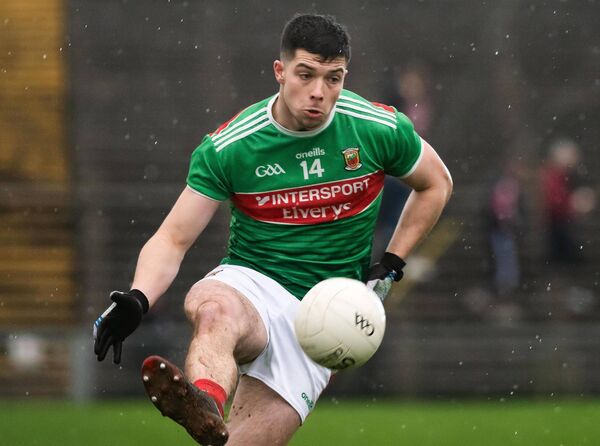
Following the untimely death of Patrick O’Hara in 1951, the garage was taken over by his sister Bridget and her husband Paddy Reape, who raised their family in St Nathy’s Cottages up to the early 1970s when they moved down the street to where their garage had re-located some years earlier. Reape’s has been an institution in Foxford for the past half century and it is great to see it being redeveloped into a new filling station following the untimely and much-lamented passing of Kevin Reape in 2023. Kevin’s son, Brian, has been a great servant to Moy Davitts, winning an All-Ireland U21 title with Mayo in 2016.
The O’Hara family’s imprint on business in Foxford is as enduring as the GAA itself. John O’Hara moved the grocery shop from Irishtown to the Corner House in the centre of the town, where his wife Bea and son JJ developed it into the thriving supermarket it is today. Mike O’Hara might have continued to run his cycle depot had he not one day bought a sweepstakes ticket for his wife Maureen. It turned out to be a winner, and the couple decided to use the money to purchase an oven for a small home bakery. The rest, as they say, is history.
Mike and Maureen O’Hara opened their little bakery in 1951, the same year that Pat Conway told the young John Durcan to take a firm grip of the Sam Maguire Cup because it might be a long time before he got to hold it again. Today, Paul Durcan is involved as a goalkeeping coach with the Mayo senior team, so perhaps this Donegal man with the strong Mayo roots can help to write the final chapter in a sporting saga that is now in its 75th year. If he does, it won’t be just ten-year-olds who will be greeting the cup with wide-eyed wonder when it finally make its long overdue return to John Durcan’s native Foxford, a town with a proud and rich GAA tradition thanks to men like Pat Conway, Tom Durcan and Dom Geoghegan.